Peptide storage and shipping: cold chain for warehouse stock
Short answerLyophilized peptide stock is stored sealed, dry, dark and cold, at the temperature on the label, commonly frozen for long-term holding or refrigerated for shorter periods. Shipping uses qualified insulated packaging with a data logger. Any excursion is assessed against stability data before the lot is released.
Key facts
- Governing document
- The storage statement on the label and certificate
- Refrigerated range
- 2 to 8 °C
- Freezer condition in ICH Q1A(R2)
- -20 °C ± 5 °C
- Main degradation drivers
- Moisture, heat, oxygen and light
- Shipping control
- Qualified packaging plus a temperature data logger
- Excursion rule
- Quarantine, assess against stability data, document
- Scope of this guide
- Warehouse and stock handling only
Cold chain means the product stays within its labeled temperature range from the filling line to your shelf. This guide covers peptide storage and shipping for warehouses, distributors and laboratory stores. It explains storage of lyophilized stock, temperature excursions, stability studies, cold-chain packaging and data loggers. It covers stock handling only and gives no instructions for use.
How lyophilized peptide stock should be stored
The label and the certificate of analysis state the storage condition for each lot. Follow that statement. The general principles behind it are the same for most peptides.
| Factor | Why it matters | Warehouse control |
|---|---|---|
| Temperature | Reaction rates rise with temperature | Monitored freezer or refrigerator with alarms |
| Moisture | Water enables hydrolysis, deamidation and aggregation | Keep containers sealed; control humidity; use desiccant for bulk |
| Oxygen | Oxidizes methionine, cysteine and tryptophan residues | Keep original closure; inert headspace where supplied |
| Light | Degrades aromatic residues | Store in cartons, away from light |
| Freeze-thaw cycling | Repeated warming causes condensation and stress | Minimize door openings; avoid frost-free freezers with defrost cycles |
| Storage condition | Usual label wording | Typical use |
|---|---|---|
| Frozen | -20 °C or below | Long-term holding of lyophilized stock and bulk powder |
| Refrigerated | 2 to 8 °C | Shorter-term holding and working stock |
| Controlled room temperature | As labeled | Only where stability data supports it |
Bulk API powder needs extra care because a container is opened more than once. Let a cold container reach room temperature before opening so that moisture does not condense on the powder. Weigh in a low-humidity area and reseal promptly. Formats are described on the lyophilized vials and bulk API powder pages.
How stability studies set storage conditions and dates
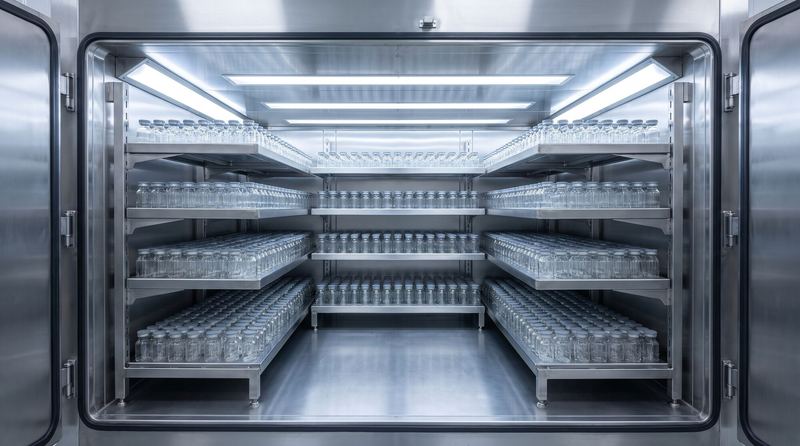
A storage statement and a retest or expiry date should rest on stability data. The standard reference is ICH Q1A(R2), which defines study conditions for drug substances and products.
| Intended storage | Long-term study condition | Accelerated study condition |
|---|---|---|
| General case | 25 °C ± 2 °C / 60% RH ± 5% RH, or 30 °C ± 2 °C / 65% RH ± 5% RH | 40 °C ± 2 °C / 75% RH ± 5% RH |
| Refrigerator | 5 °C ± 3 °C | 25 °C ± 2 °C / 60% RH ± 5% RH |
| Freezer | -20 °C ± 5 °C | Not specified; short excursions studied at an elevated temperature |
In a stability study, samples are held at these conditions and tested at intervals for purity, content, water and appearance. The results show how fast the material changes and support the date on the label. ICH Q1A(R2) applies formally to registered drug substances and products. For research-grade material it is a useful benchmark for what good data looks like.
Ask a supplier three questions:
- What the retest or expiry date is based on.
- Whether data exists for the shipping condition as well as the storage condition.
- Which attributes were tested, and by which methods.
Degradation products are covered in HPLC purity explained. The link between residual moisture and stability is covered in lyophilization explained.
How to handle a temperature excursion
An excursion is time spent outside the labeled range. Good distribution practice treats it as a deviation to investigate, not as an automatic rejection or an automatic pass. The EU's good distribution practice framework and the WHO's model guidance for the storage and transport of time- and temperature-sensitive pharmaceutical products both require documented handling.
- Quarantine. Move the stock to the correct condition and mark it as on hold.
- Record. Note the lot numbers, the duration, the peak temperature and the cause, from the logger or monitoring system.
- Assess. Compare the excursion with the supplier's stability data. Many quality teams use mean kinetic temperature to express the cumulative thermal stress of a varying temperature record.
- Decide. Release, retest or reject. The supplier's quality unit should confirm the assessment in writing.
- Correct. Fix the cause, such as a failed unit, a packaging shortfall or a customs delay.
| Excursion | Likely handling |
|---|---|
| Short, within the range covered by stability data | Release with documented assessment |
| Outside studied range, or duration unknown | Retest against specification before any release |
| No temperature record | Treat as unassessed; retest or reject |
| Visible change to the cake | Hold and report to the supplier |
Which formats need temperature-controlled packing
The label decides. The table shows the usual position by format across the trade, so a buyer knows what to expect on a quote. It is a guide, not a storage instruction.
| Format | Usual shipping condition | Why |
|---|---|---|
| Freeze-dried (lyophilized) vials | Often ambient for short transit; storage as labeled on arrival | The dry cake has very little water for degradation reactions |
| Tablets and capsules | Ambient, kept dry | Solid forms with low moisture |
| Cosmetics | Ambient, protected from heat and freezing | Emulsions can separate at extremes |
| Solution vials | Temperature-controlled packing | The peptide is in water, where degradation is faster |
| Cartridges and pens | Temperature-controlled packing | Filled with solution; shorter shelf life |
At International Wholesale Peptides the shipping condition for each item is stated on the quote and the storage condition on the label and certificate. Temperature-controlled packing, where an item needs it, is a separate line on the quote.
How cold-chain packaging works for peptide storage and shipping
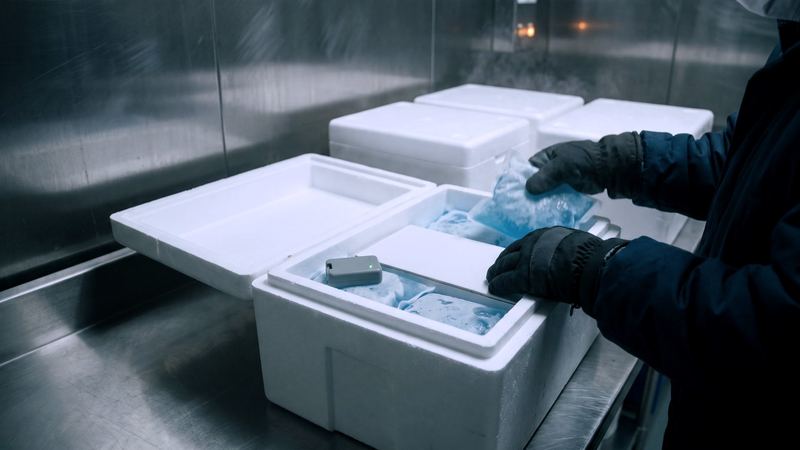
A passive shipper keeps product in range for a defined time by combining insulation with a refrigerant.
| Component | Options | Notes |
|---|---|---|
| Insulation | Expanded polystyrene, polyurethane, vacuum insulated panels | Higher performance gives longer duration in a smaller box |
| Refrigerant for 2 to 8 °C | Water-based gel packs, phase change materials | Phase change materials hold a set temperature more precisely |
| Refrigerant for frozen | Frozen gel packs, dry ice | Dry ice is regulated for air transport as UN 1845 and must be declared |
| Payload protection | Dividers, secondary cartons | Prevents direct contact between frozen refrigerant and refrigerated product |
| Monitoring | Data logger or indicator | Placed with the payload |
Packaging should be qualified. Qualification means testing the packed configuration against a temperature profile that represents the route and season, with loggers in the payload, and showing that it holds range for the claimed duration. A summer profile and a winter profile usually need different pack-outs.
Plan the route with a margin. International shipments can wait at customs, so the qualified duration should exceed the expected transit time. Dispatch early in the week. Customs preparation is covered in importing peptides.
How data loggers are used
| Device | What it records | Use |
|---|---|---|
| Electronic data logger | Time-stamped temperature at set intervals | Standard evidence for shipments and storage mapping |
| Real-time tracker | Temperature and location, transmitted live | High-value or long international routes |
| Chemical indicator | A color change when a threshold is crossed | Low-cost check; no duration data |
| Fixed monitoring probe | Continuous temperature in a store, with alarms | Refrigerators, freezers and cold rooms |
Set the practice in writing:
- Use calibrated devices, with calibration traceable to a recognized standard.
- Start the logger before packing and place it next to the product, not against the refrigerant.
- Set alarm limits to the labeled range.
- Download and review the record at receipt, before release from quarantine.
- Keep the record with the receiving documents for the lot.
Storage areas should be temperature mapped to find warm and cold spots, and monitoring probes should sit at the worst-case positions.
A receiving checklist for peptide stock
| Check | Accept when |
|---|---|
| Outer packaging | Intact, no crushing or wetness |
| Refrigerant | Still in its expected state |
| Data logger | Record complete and within range |
| Documents | Packing list, certificate of analysis and origin statement present |
| Lot numbers | Label, packing list and certificate agree |
| Container seals | Intact; stoppers and crimps undamaged |
| Appearance | Cake intact and as described on the certificate |
| Storage | Moved to the labeled condition without delay |
Record the checks, quarantine the lot until they are reviewed, and report any discrepancy to the supplier promptly. Confirm the lot against its certificate; our lot lookup is available for that step.
How International Wholesale Peptides ships stock
Stock-list items leave in 2 to 5 business days after an order is confirmed and paid. Most product is made to order in about 3 weeks. A transit damage report is made within 48 hours of delivery, with photographs, as set out under report a lot issue on the quality page. Each lot ships with a certificate of analysis that names the testing laboratory and states the storage condition. For international orders we confirm the lawful route in writing before taking the order. The quality page describes our test panel, and receiving-side supplier checks are set out in how to qualify a peptide supplier.
Frequently asked questions
What temperature should lyophilized peptides be stored at?
Store them at the temperature stated on the label and certificate of analysis for that lot. Lyophilized peptides are commonly held frozen for long-term storage or refrigerated at 2 to 8 °C for shorter periods. The supplier's stability data, not a general rule, sets the condition.
What is a temperature excursion?
An excursion is any period in which a product is outside its labeled storage range, in storage or in transit. It does not automatically mean the product is unusable. The lot is quarantined and assessed against stability data, and the decision is documented.
Why do peptide shipments need a data logger?
A data logger records temperature at set intervals from dispatch to receipt. It is the only objective evidence that the shipment stayed within range. Without a record, the receiving warehouse cannot show that the cold chain held and cannot assess an excursion.
Can lyophilized peptides ship at ambient temperature?
Only if the supplier's stability data supports the expected time and temperature of the route. Lyophilized material is more stable than solution, but stability differs by sequence. The shipping specification should state the permitted condition and the supporting data.
How does moisture damage lyophilized peptides?
Water increases molecular mobility in the dried cake and enables hydrolysis, deamidation and aggregation. Lyophilized peptides are hygroscopic, so an opened or poorly sealed container takes up water from the air. Containers should stay sealed and should reach room temperature before opening to avoid condensation.
What should a warehouse check when peptide stock arrives?
Check the outer packaging, the refrigerant state, the data logger record, the lot numbers against the packing list and certificate, the container seals and the appearance of the cake. Record the results and quarantine the lot until the checks are reviewed.
Related pages
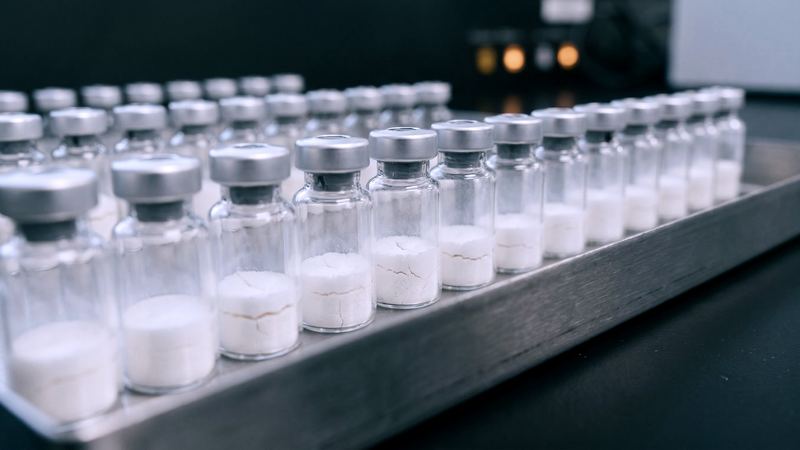 Lyophilized peptide vials wholesaleInternational Wholesale Peptides sells lyophilized peptide vials wholesale to verified trade buyers in kits of 10 vials. Each lot carries a certificate of analysis…
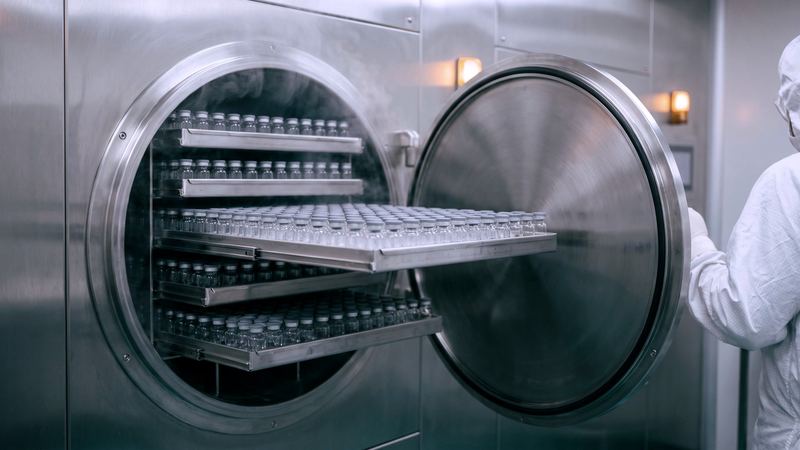 Peptide lyophilization explainedPeptide lyophilization is freeze-drying: the peptide solution is frozen, ice is removed by sublimation under vacuum in primary drying, and bound water is removed…
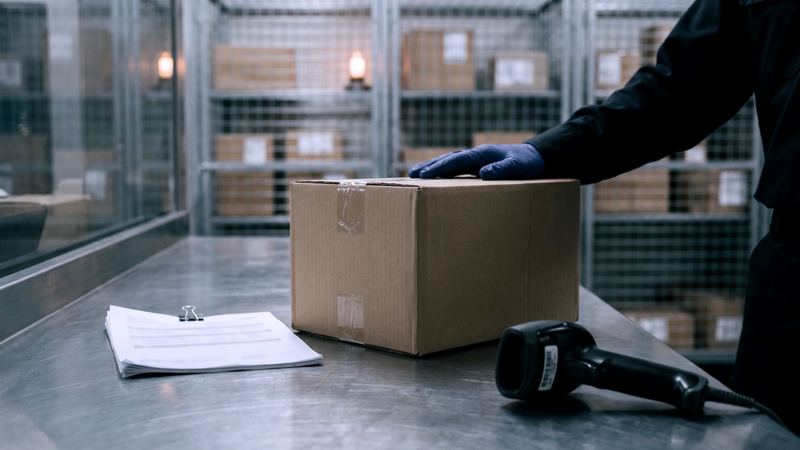 Importing peptides: classification, licensed importers and customsImporting peptides lawfully depends on how the destination country classifies the product: medicine, active ingredient, cosmetic ingredient or laboratory chemical. Classification follows presentation and…Peptide quality testing and documentationEvery International Wholesale Peptides lot ships with a certificate of analysis that names the testing laboratory and reports identity by mass spectrometry, purity by…