Wholesale peptide pricing: what drives it and how to compare quotes
Short answerWholesale peptide pricing is set by synthesis scale, sequence length and difficulty, purity grade, origin, the testing panel, fill-and-finish format, cold chain and order minimums. Compare quotes on total landed cost per unit of net peptide, including duty, import VAT, brokerage and freight.

Key facts
- Main cost drivers
- Scale, sequence, purity, origin, testing, format, cold chain
- Price bands at IWP
- By order value: under US$10,000; US$10,000 to US$20,000; US$20,000 to US$30,000; US$30,000 and over
- Volume breaks at IWP
- 50, 150, 300 and 500 kits per item; one kit is 10 vials
- Reached level
- Kept on later orders of that item
- First order
- From US$10,000 made to order; evaluation order of stock-list items from US$2,500, once per account
- Public price list
- None; the trade price list at every band is sent with account approval
- Purity and content
- Different numbers; check both against the label quantity
- Comparison basis
- Landed cost per milligram of net peptide
Wholesale peptide pricing looks inconsistent until quotes are broken into their components. This guide explains the cost drivers, how volume breaks work and how to build a total landed cost. It contains no market price figures, because a figure without a specification is not comparable.
How wholesale peptide pricing works
A wholesale quote reflects three layers of cost.
| Layer | What it covers | Behavior with volume |
|---|---|---|
| Active ingredient | Synthesis, purification, salt exchange, bulk lyophilization | Falls sharply with scale |
| Conversion | Fill and finish, vials, stoppers, labels, kitting | Falls moderately with scale |
| Assurance and delivery | Testing, documentation, storage, cold-chain freight | Largely fixed per lot or per shipment |
The fixed share explains why small orders cost more per vial. A lot must be tested whether it yields 100 vials or 10,000.
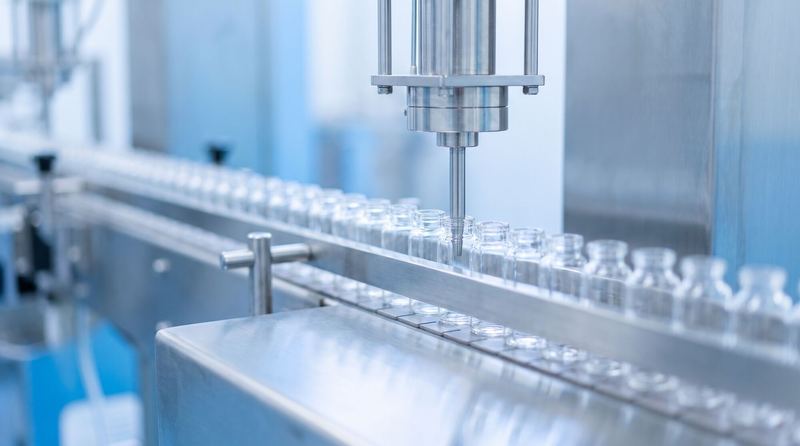
What drives the price of a peptide
| Driver | Effect on cost | What to check in a quote |
|---|---|---|
| Synthesis scale | Larger batches spread setup, labor and purification cost | Batch size behind the lot |
| Sequence length | Each added residue adds a coupling cycle and lowers crude yield | Number of residues |
| Sequence difficulty | Aggregation-prone or hindered sequences need extra steps | Whether the item is stock or custom |
| Modifications | Cyclization, lipidation, PEGylation and metal complexes add steps | Exact structure and salt form |
| Purity grade | Tighter cuts in preparative HPLC discard more product | Purity limit and method |
| Origin | Labor, facility and compliance costs differ by country | Synthesis site and fill site |
| Testing panel | Each test adds laboratory cost per lot | Tests listed on the certificate |
| Fill and finish | Aseptic filling and lyophilization need controlled facilities | Vial size, fill basis, sterility claim |
| Cold chain | Insulated packaging, refrigerants and loggers add freight cost | Shipping specification |
| Minimums | Small orders carry the same fixed costs | Order minimum and break points |
Sequence length has a compounding effect. At 99% efficiency per coupling cycle, a 10-residue peptide gives roughly 91% full-length product in the crude material, and a 30-residue peptide roughly 75%. The remainder must be removed by purification, which is the most expensive step. The chemistry is covered in peptide synthesis explained.
Purity has a similar effect. Moving from 95% to 98% and then to 99% narrows the fraction collected from each preparative run.
Why the quantity basis changes the real price
A vial labeled with a quantity can refer to gross lyophilized powder or to net peptide. The difference is counter-ion and water. Two quotes at the same price per vial can differ materially in price per milligram of net peptide.
| Quote | Label quantity basis | Net peptide content | Net peptide per 10 mg vial |
|---|---|---|---|
| A | Gross powder | 78% | 7.8 mg |
| B | Net peptide | Not applicable | 10.0 mg |
Purity and content are different numbers. Purity says how much of the peptide present is the right peptide. Content says how much peptide is in the vial. A lot can pass one and fail the other. Check both against the label quantity.
A quote far below the market for the same item, strength and quantity is a reason to ask for the content result on that lot.
The figures in the table are illustrative. Ask every supplier which basis it uses and confirm it on the certificate. Our guide on how to read a peptide COA explains the content fields.
How volume breaks work
A volume break is a lower unit price above a quantity threshold. Breaks exist because fixed costs per lot and per shipment are divided across more units.
| Feature | How it usually works |
|---|---|
| Threshold unit | Per item, not across the whole order |
| Typical unit | Vials, kits, grams or kilograms |
| Mixed orders | Breaks may or may not combine across items; ask |
| Reserved lots | Larger commitments can reserve a lot or a forward schedule |
| Custom items | Priced per synthesis, with a higher minimum |
At International Wholesale Peptides, price is set in two ways. The value of the order places it in one of four bands, and each item has its own volume breaks.
| Order value | Price band |
|---|---|
| Under US$10,000 | First band |
| US$10,000 to US$20,000 | Second band |
| US$20,000 to US$30,000 | Third band |
| US$30,000 and over | Fourth band, the lowest price |
| Per-item volume break | Units |
|---|---|
| 50 kits | 500 |
| 150 kits | 1,500 |
| 300 kits | 3,000 |
| 500 kits | 5,000 |
One kit is 10 vials. A reached level is kept: once an account reaches a price level on an item, later orders of that item keep it. The full trade price list at every band is sent with account approval, together with the current stock list.
A first order of made-to-order product starts from US$10,000. A buyer who wants to test before a production order can place one evaluation order of stock-list items from US$2,500, once per account. Payment is by bank wire or ACH, prepaid. Cards are not accepted. Full conditions are in the wholesale terms. Minimums are explained in minimum order quantities.
How to calculate total landed cost
For any cross-border order, the product price is only the first line. The delivery term decides which party pays each cost. The Incoterms rules published by the International Chamber of Commerce define those responsibilities.
| Cost line | What it is | Who usually sets it | How to estimate |
|---|---|---|---|
| Product price | Supplier invoice value | Supplier | Quote |
| International freight | Air freight or courier, by chargeable weight | Carrier | Freight quote for the packed shipper |
| Cold-chain packaging | Insulated shipper, refrigerant, data logger | Supplier or forwarder | Per shipper |
| Insurance | Cargo cover for loss or temperature damage | Insurer | Percentage of insured value |
| Customs duty | Tariff on the customs value | Destination customs | Tariff rate for the classification code |
| Import VAT or sales tax | Tax on customs value plus duty and, in many countries, freight | Destination tax authority | National rate; often recoverable by registered businesses |
| Brokerage and clearance | Customs broker fee, entry fees, handling | Broker and carrier | Fixed fee per entry |
| Regulatory costs | Import permits, licensed importer fees, release testing | Regulator or importer | Depends on product class |
| Inland delivery | Final temperature-controlled leg | Local carrier | Per shipment |
Duty depends on the tariff classification of the goods and their customs value. Classification follows the Harmonized System and depends on what the product is and how it is presented. Rates can be checked in the US Harmonized Tariff Schedule, the UK Trade Tariff or the EU's TARIC database. The importer of record is responsible for the declaration, so confirm the code with a customs broker. See importing peptides for the regulatory side.
A landed cost worksheet
Use this structure with your own figures.
| Line | Formula |
|---|---|
| A. Product value | Units × unit price |
| B. Freight, packaging and insurance | Quoted amounts |
| C. Customs value | A, or A + B, depending on the country's valuation basis |
| D. Duty | C × duty rate |
| E. Import VAT or sales tax | (C + D, plus freight where applicable) × tax rate |
| F. Brokerage, permits, inland delivery | Quoted amounts |
| G. Landed cost | A + B + D + E + F, less any recoverable tax |
| H. Landed cost per mg of net peptide | G ÷ total net peptide in the shipment |
Line H is the figure that makes quotes comparable across suppliers, origins and pack formats.
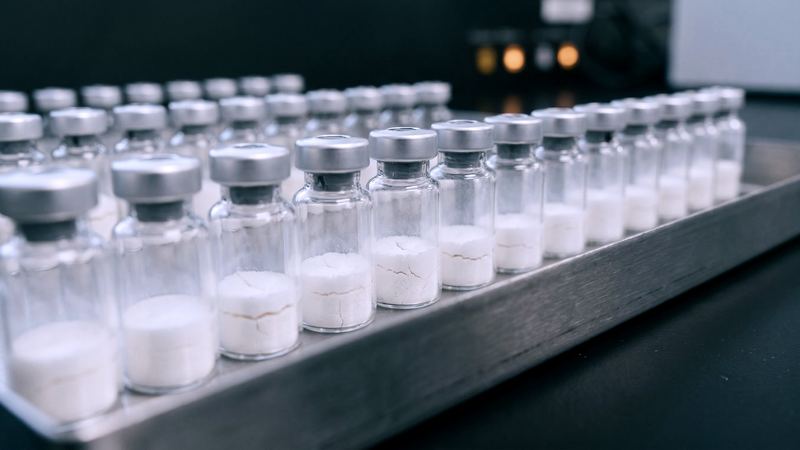
How to compare two quotes fairly
- Align the specification: compound, salt form, purity limit, fill quantity and its basis.
- Align the evidence: lot-specific certificate, named laboratory, tests reported.
- Align the origin statement: synthesis site and fill site.
- Align delivery terms and convert both quotes to landed cost.
- Divide by net peptide, not by vial count.
- Add the cost of your own incoming testing if one supplier's evidence is weaker.
A lower price with weaker evidence shifts cost to the buyer's quality function. The checks are set out in how to qualify a peptide supplier.
How to get a quote from International Wholesale Peptides
We do not publish prices. The sequence is apply, business verification, quote, order. Quotes state the origin statement, specification and delivery terms. Stock-list items leave in 2 to 5 business days, and most product is made to order in about 3 weeks. Start with the wholesale peptides overview, then use the application page.
Frequently asked questions
Why do wholesale peptide prices vary so much between suppliers?
Quotes differ because the products differ. Synthesis scale, purity grade, origin, salt form, fill quantity basis, test panel and packaging all change cost. Two quotes for the same compound name are comparable only when the specification, the certificate evidence and the delivery terms are the same.
How do volume price breaks work for peptides?
Suppliers set a unit price for a base quantity and lower prices at defined thresholds, because larger lots spread fixed synthesis, testing and setup costs. At International Wholesale Peptides, breaks apply at 50, 150, 300 and 500 kits per item, where one kit is 10 vials, and a reached level is kept on later orders of that item.
What is total landed cost for imported peptides?
Total landed cost is the product price plus international freight, insurance, customs duty, import VAT or sales tax, brokerage and clearance fees, cold-chain packaging and any regulatory or testing costs at destination. It is the figure to use when comparing a domestic quote with an imported one.
Why does a US-synthesized peptide cost more?
Domestic synthesis carries higher labor, facility and compliance costs, and usually smaller production scale per item. Buyers pay the premium for a shorter supply chain, easier audit access and documented synthesis and fill sites, not for a different molecule.
Does higher purity always justify a higher price?
Only if the application needs it. Each additional purification pass discards material, so cost rises steeply above 98%. Match the purity grade to the specification, and check net peptide content as well, because purity alone does not show how much peptide a vial contains.
Why are peptide prices not published?
Trade suppliers quote after verifying the buyer because price depends on product class, volume, line, destination and documentation, and because supply is restricted to eligible businesses. International Wholesale Peptides sends its trade price list, at every order-value band, with account approval and does not publish prices.
Related pages
 Wholesale peptides for verified trade buyersWholesale peptides are sold business to business in kits, bulk powder or private-label lots, not to individuals. International Wholesale Peptides supplies verified buyers under…
 Wholesale peptide minimum order and payment termsPrice is set by order value in four bands, with the lowest price at US$30,000 and over. A first made-to-order order starts at US$10,000.…Peptide minimum order quantity: how MOQs workA peptide minimum order quantity is the smallest amount a supplier will sell, set per item, per kit, per lot or as an order…
 Bulk peptides in kits and API powderBulk peptides are supplied in two forms: lyophilized vials in kits of 10 with per-item price breaks at 50, 150, 300 and 500 kits,…