Importing peptides: classification, licensed importers and customs
Short answerImporting peptides lawfully depends on how the destination country classifies the product: medicine, active ingredient, cosmetic ingredient or laboratory chemical. Classification follows presentation and intended use, not the label. Medicines and active ingredients normally require a licensed importer or wholesale dealer. Confirm the route with the regulator first.
Key facts
- What decides classification
- Composition, presentation and intended use
- Effect of a research label
- None on classification
- Usual route for medicines and APIs
- Licensed importer, wholesale dealer or pharmacy
- Customs basis
- Harmonized System code and customs value
- Transport
- Temperature-controlled with a data logger
- Countries IWP supplies
- Worldwide; every country assessed on request
- Regulatory date
- General information as of November 2026
Importing peptides is a regulatory question before it is a logistics question. The same vial can be a medicine in one country, a laboratory chemical in another and a refused shipment in a third. This guide explains how classification works in general, the role of a licensed importer, customs and duty basics, cold chain, and which regulator to ask in five markets. It is general information as of November 2026, not legal advice.
How classification works when importing peptides
Health regulators and customs authorities classify separately. Both look at the product, not the name on the invoice.
| Possible classification | What usually triggers it | Typical consequence |
|---|---|---|
| Medicinal product or drug | Presented for human or veterinary use, or acts pharmacologically when used as intended | Marketing authorization or a specific exemption; licensed importer and wholesaler |
| Active pharmaceutical ingredient | Bulk substance intended for making a medicine | Registered or licensed API importer; manufacturing evidence |
| Cosmetic ingredient | Raw material for topical cosmetic products | Chemical and cosmetics rules; the finished product needs a responsible person |
| Laboratory chemical or reagent | Supplied to institutions for in vitro or analytical work | Chemical safety and customs rules; end-use evidence may be requested |
| Controlled or prohibited substance | Listed under national law | Permit, or no lawful route |
Three factors decide the outcome.
Composition. What the substance is and whether it appears on a national list.
Presentation. The container, pack and labeling. A sterile vial in a consumer-style kit is presented differently from a drum of bulk powder.
Intended use. The purpose shown by labeling, marketing, website content, the customer type and the seller's conduct. The UK regulator's guidance on borderline products describes this approach, and FDA applies an intended-use test in the United States.

Why research labeling does not change classification
A statement that a product is for research does not settle its status. Regulators look at the whole picture. If the presentation, marketing or customer base indicates human use, the product can be classified as a medicine regardless of the label. Importers should not rely on label wording as a route to market.
Research-grade peptides from International Wholesale Peptides are for laboratory research by verified institutions and are not for human or veterinary use. We verify the buyer and the route accordingly.
What a licensed importer or wholesale dealer does
Where a product is a medicine or an active ingredient, most countries restrict import and wholesale to licensed businesses. The license holder takes legal responsibility for what enters the market.
| Function | What the license holder does |
|---|---|
| Importer of record | Makes the customs declaration and pays duty and tax |
| Regulatory authorization | Holds the import, wholesale or manufacturing license the product class requires |
| Supplier qualification | Verifies the foreign supplier and manufacturer |
| Receipt and release | Checks documents, temperature record and identity on arrival; quarantines until release |
| Storage and distribution | Applies good distribution practice; supplies only to eligible customers |
| Records and recalls | Keeps traceability records and can recall a lot |
In the European Union, wholesale distribution of medicines requires an authorization and compliance with good distribution practice. In the United Kingdom, the MHRA issues manufacturer and wholesale dealer licences.
Clinics are supplied only through a licensed pharmacy or licensed importer in their country. Our page for distributors and importers describes how we work with license holders.
Which regulator to check in each market
The table lists the authority to ask and the route that normally applies. It does not state that any product is permitted. Confirm the position for your product and buyer class with the regulator or with counsel.
| Market | Regulator to check | Usual lawful route for medicines and APIs | Country page |
|---|---|---|---|
| United Kingdom | MHRA | Holder of the relevant MHRA licence, such as a wholesale dealer's licence; unlicensed medicines follow a separate notification scheme | United Kingdom |
| European Union | The national competent authority of the member state, within the framework of Directive 2001/83/EC and EMA guidance | Holder of a manufacturing and import authorization or wholesale distribution authorization; registered API importer | European Union |
| United Arab Emirates | The federal drug regulator: the Ministry of Health and Prevention (MOHAP) and the Emirates Drug Establishment; emirate health authorities also have roles | Licensed local agent or medical warehouse with an import permit | UAE |
| Canada | Health Canada | Holder of a drug establishment licence covering importation, where the product is a drug | Canada |
| Mexico | COFEPRIS | Holder of the applicable sanitary authorization and import permit | Mexico |
In the UAE, federal responsibility for medical products has been moving from MOHAP to the Emirates Drug Establishment. Check which authority handles your application at the time you apply.
How customs and duty work
Every commercial shipment needs a customs declaration in the destination country.
| Element | What it is | Who is responsible |
|---|---|---|
| Tariff classification | A code under the Harmonized System, extended nationally | Importer of record, with a broker |
| Customs value | Normally the transaction value, with freight and insurance added in many countries | Importer of record |
| Country of origin | Determined under customs origin rules | Declared by the importer from supplier documents |
| Duty | Tariff rate applied to customs value | Paid by the importer |
| Import VAT or sales tax | National tax on the imported value | Paid by the importer; often recoverable by registered businesses |
| Supporting documents | Commercial invoice, packing list, air waybill, certificate of analysis, licenses or permits | Supplier and importer |
Peptides do not have one tariff code. A bulk chemical, a product put up in measured form and a cosmetic raw material can each classify differently. Rates can be checked in the UK Trade Tariff or the EU's TARIC database, and a customs broker should confirm the code.
The invoice description must be accurate. Describing goods as something else to ease clearance is a customs offense and can void insurance.
What documents ship with an export order
An importer needs more than an invoice. The export document pack below is what International Wholesale Peptides (IWP) can supply with an export order. The first three rows travel with every order. The others are prepared on request, and the quote confirms which of them apply to the product and the destination.
| Document | For | Position |
|---|---|---|
| Commercial invoice and packing list | Customs entry and warehouse receipt | With every export order |
| Certificate of analysis per lot | The importer's quality file | With every lot |
| Origin statement per lot | The origin declaration and the importer's file | With every lot |
| Manufacturing-standard (GMP) declaration | The importer's file and the registration dossier | On request; confirmed on the quote |
| Regulatory status declaration per product | Classification at destination | On request; confirmed on the quote |
| Letter authorizing the distributor for its country | Registration and tenders | On request, by written agreement |
| Master-case and case-pack labels | Customs and warehouse receipt | On request; layout confirmed on the quote |
| Labels and inserts in the destination language | Where local rules require it | On request; stated on the quote |
| Raw-material certificate for the active | Chain of custody from the active to the finished lot | On request |
The manufacturing-standard declaration states the standard the lot was made under. It is not a registration with any regulator and should not be presented as one. The importer of record decides which documents its regulator and customs authority require, and asks for them before the order is placed, not after the goods have left.
How cold chain affects an import
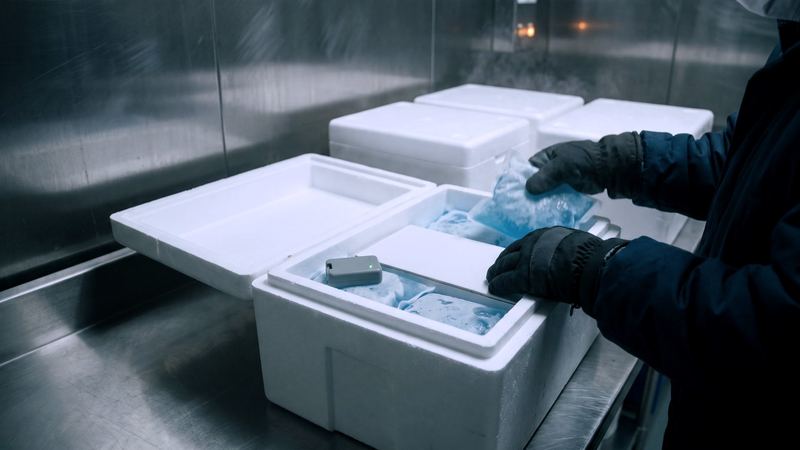
Cold chain means the product stays within its labeled temperature range from the filling line to your shelf.
Customs holds add time. A shipment qualified for 72 hours of temperature control can fail if clearance takes longer.
- Clear the regulatory route and the customs code before dispatch.
- Send documents to the broker in advance of the flight.
- Use packaging qualified for the route plus a margin for delay.
- Include a data logger and agree in writing who reviews the record on arrival.
- Avoid dispatch before weekends and public holidays at destination.
Details are in peptide storage and cold chain.
A pre-shipment checklist for importers
- Identify the product class and the buyer class.
- Ask the destination regulator how the product is classified. Keep the reply.
- Identify the license holder who will act as importer of record.
- Obtain any import permit before the goods leave.
- Confirm tariff code, duty and tax with a broker.
- Agree delivery terms, packaging and logger requirements.
- Collect the invoice, packing list, certificate of analysis and origin statement, and request any declarations, authorization letter or case labels the destination requires.
- Plan receipt, quarantine and release at the destination warehouse.
How International Wholesale Peptides handles international orders
Every country has its own rules. We ship only where a lawful route exists for that product and buyer, normally through a licensed importer or licensed pharmacy in the destination country, and we confirm the route in writing before taking an order. Supply is worldwide on that basis. Every country is assessed on request, and where a market restricts a product class the route is assessed case by case. Dispatch is to the buyer's registered site or its licensed importer. Nothing is sent to individuals. Buyers can begin on the application page, and the capabilities page lists the same document pack beside the formats it applies to.
Frequently asked questions
Do I need a license for importing peptides?
It depends on the product's classification in the destination country. Products classified as medicines or active pharmaceutical ingredients normally require a licensed importer, wholesale dealer or pharmacy. Cosmetic ingredients and laboratory chemicals follow other rules. Ask the national regulator before ordering, and get the answer in writing where possible.
Does a research label make a peptide easier to import?
No. Regulators classify a product by its composition, presentation and intended use, including how it is marketed and to whom it is sold. A research label does not change that classification. A vial presented for human use can be treated as a medicine whatever the label says.
What customs code applies to peptides?
There is no single code. Classification under the Harmonized System depends on the substance and its presentation, for example a bulk chemical compared with a product put up in measured form. The importer of record is responsible for the declaration and should confirm the code with a customs broker.
Who is the importer of record for a peptide shipment?
The importer of record is the party legally responsible for the customs declaration, duties and compliance with import rules. For regulated products this is normally the licensed importer, wholesale dealer or institution in the destination country, not the foreign supplier or the carrier.
What happens if a peptide shipment is held at customs?
Customs or the health regulator may ask for documents such as an invoice, certificate of analysis, import license or end-use statement. Without the required authorization, goods can be refused, returned or destroyed. Temperature control during a hold is a further risk, so resolve the route before shipping.
Which countries does International Wholesale Peptides supply?
We supply worldwide, wherever a lawful route exists for the product and buyer, normally through a licensed importer or licensed pharmacy. Every country is assessed on request. Where a market restricts a product class, the route is assessed case by case, and we confirm the route in writing before taking an order.
Related pages
 International peptide supplier: worldwide supply by regionInternational Wholesale Peptides is an international peptide supplier to verified businesses worldwide. Each order ships by the lawful route for the product and buyer,…Peptide distributor supplyA peptide distributor buys from International Wholesale Peptides on a trade account. Price is set by order value in four bands. A distributor registers…
 Peptide storage and shipping: cold chain for warehouse stockLyophilized peptide stock is stored sealed, dry, dark and cold, at the temperature on the label, commonly frozen for long-term holding or refrigerated for…
 Wholesale peptide pricing: what drives it and how to compare quotesWholesale peptide pricing is set by synthesis scale, sequence length and difficulty, purity grade, origin, the testing panel, fill-and-finish format, cold chain and order…