Peptide minimum order quantity: how MOQs work
Short answerA peptide minimum order quantity is the smallest amount a supplier will sell, set per item, per kit, per lot or as an order value. Minimums recover fixed costs for synthesis, testing, filling and labels. Custom synthesis and private label carry higher minimums than stock items.

Key facts
- Ways an MOQ is set
- Per item, per kit, per lot or by order value
- IWP first order
- From US$10,000 for made-to-order product
- IWP evaluation order
- Stock-list items from US$2,500, once per account
- IWP kit size
- One kit is 10 vials
- IWP volume breaks
- 50, 150, 300 and 500 kits per item; a reached level is kept
- IWP private label
- By format, on the quote: typically 50 kits or 250 units
- Payment at IWP
- Bank wire or ACH, prepaid
- Lead time at IWP
- Stock list 2 to 5 business days; made to order about 3 weeks
A peptide minimum order quantity, or MOQ, is the smallest amount a supplier will sell in one order. It is a commercial rule that reflects real fixed costs. This guide explains how MOQs are set per item, per kit and per lot, why custom synthesis and private label have higher minimums, and how to plan a first order.
How a peptide minimum order quantity is set
Suppliers express minimums in four ways. One order can be subject to more than one.
| Basis | What it means | Where it is used |
|---|---|---|
| Per item | A minimum number of units of each product | Stock vials; cosmetic actives |
| Per kit | Product is sold in fixed multiples, such as a kit of 10 vials | Lyophilized vials |
| Per lot | The buyer takes an entire production lot or a fixed share of it | Custom synthesis; reserved lots; private label |
| Order value | A minimum invoice total across all items | Account opening; trade terms |
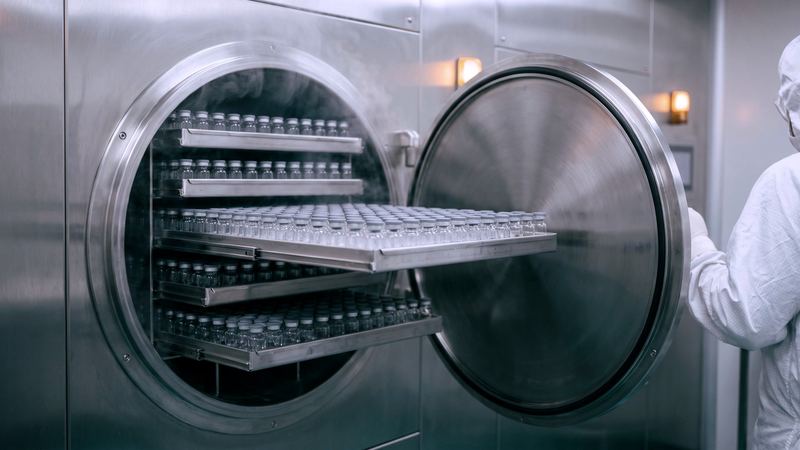
A kit is a packing unit. At International Wholesale Peptides, one kit is 10 vials, and volume price breaks apply at 50, 150, 300 and 500 kits per item.
Why suppliers set minimums
Each order carries costs that do not shrink with the quantity.
| Fixed cost | Why it does not scale down |
|---|---|
| Synthesis setup | Reactor preparation, resin loading and cleaning are the same for a small batch |
| Purification | Column setup, method runs and fraction analysis are needed for any batch |
| Testing | One full test panel per lot, regardless of lot size |
| Fill and finish | Line setup, clearance and lyophilizer cycle time are per run |
| Labels and packaging | Print runs and artwork setup are per design |
| Verification and documents | Buyer verification, certificates and export paperwork are per account or per order |
| Cold-chain shipping | Insulated shipper, refrigerant and logger are per box |
A minimum is the point at which these costs are covered at an acceptable unit price. Below it, either the supplier loses money or the buyer pays a price that makes little sense. The cost structure is explained in wholesale peptide pricing.
How minimums differ by product type
| Product type | Usual MOQ basis | Relative minimum | Reason |
|---|---|---|---|
| Stock lyophilized vials | Per kit, plus order value | Lowest | Lot already made and tested |
| Stock bulk API powder | Minimum weight per item | Low to moderate | Repacking and retesting per withdrawal |
| Cosmetic peptide actives | Minimum weight or volume per item | Low to moderate | Stock raw materials |
| Reserved lot of a stock item | Per lot or agreed share | Moderate to high | Stock withdrawn from general sale |
| Private-label finished goods | Per item and per print run, plus account commitment | High | Dedicated labels, allocation and setup |
| Custom synthesis | Per batch | Highest per item | Dedicated production and method work |
Why custom synthesis has higher minimums
A custom synthesis is made for one buyer. Nothing can be sold to anyone else, so the buyer carries every cost.
- Batch economics. Synthesis scale is set by resin quantity and reactor size. A run below the practical minimum of the equipment still consumes setup time and solvent.
- Yield uncertainty. A new or difficult sequence may give low crude purity, so the supplier plans a larger batch to deliver the ordered amount.
- Method development. A new compound needs a purification method, an analytical method and a reference characterization.
- Full testing. The lot needs its own identity, purity and content results, plus any added tests.
The chemistry behind yield is covered in peptide synthesis explained.
Why private label has higher minimums
Private label adds brand-specific costs to a product that may otherwise be standard.
| Cost | Effect on the minimum |
|---|---|
| Label printing | Print runs have a minimum quantity per design and per size |
| Artwork and proofing | Fixed cost per design, repeated at each revision |
| Lot reservation | A reserved lot is unavailable to other buyers |
| Line setup | Labeling and kitting are set up and cleared per configuration |
| Documentation | Buyer-specific product names on certificates and packing records |
| Inventory risk | Labeled stock cannot be resold if the buyer does not take it |
At International Wholesale Peptides, the private label minimum is set by format and stated on the quote: typically 50 kits (500 units) for vials, tablets and pet products, and 250 units for cosmetics and nasal sprays. A first private-label order takes 4 to 6 weeks from approved artwork. See private label peptides and the comparison in white label vs private label peptides.
What minimums apply at International Wholesale Peptides
There is one kind of account, the trade account. Price is set by order value in four bands, and each item has its own volume breaks. Full conditions are in the wholesale terms.
| Order type | Minimum | Notes |
|---|---|---|
| Evaluation order | From US$2,500 | Stock-list items only, once per account, so a buyer can test before a production order |
| First order, made to order | From US$10,000 | Most product is made to order in about 3 weeks |
| Private label, vials, tablets and pet products | Typically 50 kits (500 units) per item | Stated on the quote |
| Private label, cosmetics and nasal sprays | Typically 250 units per item | Stated on the quote |
| Supply program | Accounts in the top band | A forward schedule with reserved capacity |
| Term | Detail |
|---|---|
| Kit | 10 vials |
| Price bands by order value | Under US$10,000; US$10,000 to US$20,000; US$20,000 to US$30,000; US$30,000 and over |
| Volume price breaks | 50, 150, 300 and 500 kits per item |
| Reached level | Kept on later orders of that item |
| Payment | Bank wire or ACH, prepaid. Cards are not accepted |
| Stock-list dispatch | 2 to 5 business days |
| Made to order | About 3 weeks |
| First private-label order | 4 to 6 weeks from approved artwork |
| Prices | Trade price list at every band, sent with account approval; no public prices |
There is no free sample program. The evaluation order is the test step.
How to plan a first order
A first order has two jobs. It supplies product, and it tests the supplier. Size it for both.
- Confirm eligibility and route. Check that your business is in a buyer class the supplier accepts and that a lawful route exists for the product in your country.
- Choose a narrow range. Fewer items in sensible quantities give a cleaner test than many items in single kits.
- Use the break points. If your forecast is close to a volume break, compare the total cost at the break with the cost just below it.
- Budget for incoming testing. Plan to test at least one lot independently. Include the units consumed by testing in the quantity.
- Check dates. Compare each lot's retest or expiry date with your expected rate of use, so that stock is not held past its date.
- Check storage capacity. Confirm freezer or refrigerator space before the shipment leaves.
- Plan the second order. Note the supplier's dispatch time and your own receiving and release time, then set a reorder point.
A simple first-order worksheet
| Line | Your figure |
|---|---|
| Items selected | |
| Kits per item | |
| Units reserved for incoming testing | |
| Expected monthly use per item | |
| Months of cover | |
| Earliest retest or expiry date in the lot | |
| Storage space required | |
| Order value against the account minimum | |
| Next volume break and the cost difference |
What to ask a supplier about minimums
- Whether the minimum is per item, per kit, per lot or by order value.
- Whether items can be mixed to reach an order value.
- Whether volume breaks apply per item or across the order.
- Whether a lot can be reserved, and on what commitment.
- What the minimum print run is for private-label labels.
- What happens to labeled stock if a forecast changes.
- Whether a repeat order from the same lot is possible.
A supplier should answer these in writing before the first invoice. To request terms, start on the wholesale peptides page or the application page.
Frequently asked questions
What is a typical peptide minimum order quantity?
There is no standard figure. Stock items are usually sold by the kit or by a minimum order value. Bulk powder is sold from a minimum weight. Custom synthesis is sold by the batch. At International Wholesale Peptides, a first order of made-to-order product starts from US$10,000, and a one-time evaluation order of stock-list items starts from US$2,500.
Why do custom synthesis orders have higher minimums?
A custom synthesis is a dedicated batch. The supplier pays for setup, raw materials, purification, method development and a full test panel whether the batch yields one gram or one hundred. The buyer takes the whole batch, so the minimum is the batch.
Why does private label need a higher minimum?
Labels are printed per run, lots are reserved for one buyer, and each buyer-specific configuration needs line setup and clearance. Those costs must be spread over enough units. At International Wholesale Peptides, the private label minimum is set by format and stated on the quote: typically 50 kits (500 units) for vials, tablets and pet products, and 250 units for cosmetics and nasal sprays.
Can I mix items to reach a minimum order value?
Usually yes where the minimum is an order value, and no where the minimum is per item or per lot. Volume price breaks normally apply per item. Ask the supplier which rule applies before building the order.
How should I size a first peptide order?
Order enough of a small number of items to test the supplier's documents, delivery and incoming test results, and keep the commitment proportionate to that goal. Scale up after the first lot matches its certificate and the temperature record is acceptable.
Does a lower MOQ mean a higher unit price?
Generally yes. Fixed costs per lot and per shipment are divided across fewer units, so small orders cost more per unit. Volume breaks reverse this. Compare offers on landed cost per unit of net peptide at the quantity you will actually buy.
Related pages
 Wholesale peptide minimum order and payment termsPrice is set by order value in four bands, with the lowest price at US$30,000 and over. A first made-to-order order starts at US$10,000.…
 Wholesale peptides for verified trade buyersWholesale peptides are sold business to business in kits, bulk powder or private-label lots, not to individuals. International Wholesale Peptides supplies verified buyers under…Wholesale peptide pricing: what drives it and how to compare quotesWholesale peptide pricing is set by synthesis scale, sequence length and difficulty, purity grade, origin, the testing panel, fill-and-finish format, cold chain and order…
 Private label peptides for verified brandsPrivate label peptides are finished goods produced under a brand's own label. International Wholesale Peptides sets the minimum by format on the quote, typically…