How peptides are synthesized: from resin to lyophilized powder
Short answerMost commercial peptides are made by Fmoc solid-phase peptide synthesis: amino acids are coupled one at a time to a chain anchored on resin, the chain is cleaved with acid, purified by preparative reversed-phase HPLC, converted to the required salt and lyophilized to a dry powder.
Key facts
- Dominant method
- Fmoc solid-phase peptide synthesis (SPPS)
- Direction of assembly
- C-terminus to N-terminus
- Fmoc removal
- Base, typically piperidine in DMF
- Cleavage
- Trifluoroacetic acid with scavengers
- Purification
- Preparative reversed-phase HPLC
- Usual salt forms
- Acetate or trifluoroacetate
- Final step
- Lyophilization
This guide explains how peptides are synthesized at commercial scale, from the first amino acid on resin to the lyophilized powder that a laboratory tests. It covers solid-phase peptide synthesis with Fmoc chemistry, cleavage, purification by preparative HPLC, salt exchange, lyophilization, scale differences and the points where impurities arise.
How peptides are synthesized by solid-phase synthesis
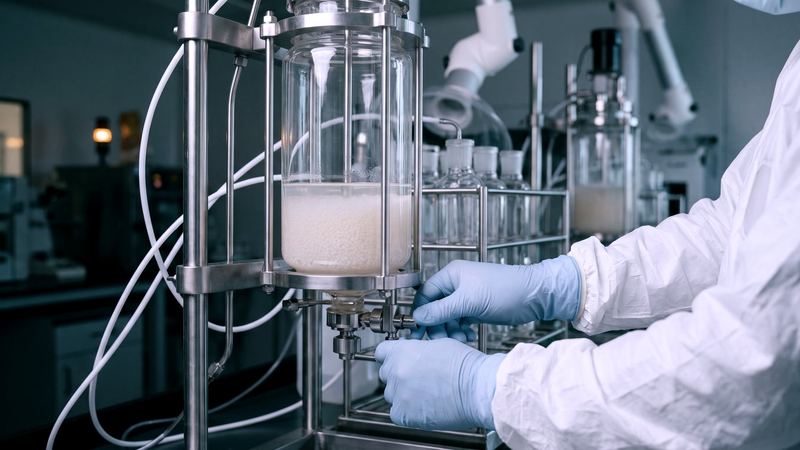
A peptide is a chain of amino acids joined by amide bonds. Solid-phase peptide synthesis (SPPS), introduced by R. B. Merrifield in 1963, builds that chain on an insoluble polymer support. The growing peptide stays attached to resin beads, so excess reagents can be washed away after every step.
The chain is built from the C-terminus toward the N-terminus. Each amino acid arrives with two kinds of protection:
- a temporary group on its alpha-amino group, removed before the next coupling;
- permanent groups on reactive side chains, removed only at the end.
In Fmoc chemistry the temporary group is Fmoc, which is removed by base. Side-chain groups such as tert-butyl, Boc, trityl and Pbf are removed by acid. Because the two sets respond to different conditions, the scheme is called orthogonal.
| Stage | What happens | Typical reagents |
|---|---|---|
| Resin loading | The first amino acid is attached through a linker | Wang or 2-chlorotrityl resin for C-terminal acids; Rink amide resin for C-terminal amides |
| Fmoc deprotection | The temporary group is removed to expose the amine | Piperidine in dimethylformamide (DMF) |
| Washing | Reagents and by-products are rinsed out | DMF |
| Coupling | The next protected amino acid is activated and forms an amide bond | Carbodiimide with an additive, or uronium and phosphonium reagents such as HBTU or HATU, with base |
| Washing | Excess amino acid and reagents are rinsed out | DMF |
| Capping (optional) | Unreacted amines are acetylated so they cannot grow further | Acetic anhydride |
| Repeat | The cycle runs once per residue |
Why coupling efficiency matters
Every cycle must run close to completion, because losses compound. The table shows the theoretical share of full-length product in crude peptide for a given average efficiency per cycle.
| Peptide length | 98% per cycle | 99% per cycle | 99.5% per cycle |
|---|---|---|---|
| 10 residues | 83% | 91% | 96% |
| 20 residues | 68% | 83% | 91% |
| 30 residues | 56% | 75% | 86% |
| 40 residues | 45% | 68% | 82% |
The figures are calculated as efficiency raised to the power of the number of coupling cycles, which is one fewer than the number of residues. They ignore side reactions, so real crude purity is lower. The pattern explains why long peptides cost more and need heavier purification; see wholesale peptide pricing.
What happens at cleavage
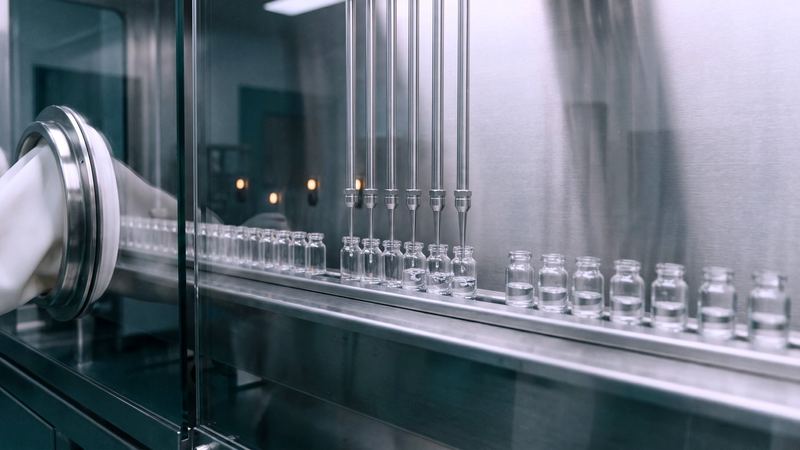
When the sequence is complete, the peptide is released from the resin and the side-chain groups are removed in one step. The usual reagent is trifluoroacetic acid (TFA) with scavengers such as water and triisopropylsilane. Scavengers trap the reactive fragments released from protecting groups, which would otherwise reattach to residues such as tryptophan, methionine, cysteine and tyrosine.
The resin is filtered off. The peptide is precipitated from the acid, usually with cold ether, collected and dried. This is crude peptide. Depending on length and sequence, it may contain anywhere from about half to most of its mass as the target sequence.
Modifications are introduced at defined points. N-terminal acetylation is done on resin before cleavage. A C-terminal amide comes from the choice of resin. Disulfide bridges and cyclizations are formed on resin or in solution after cleavage. Metal complexes such as GHK-Cu are formed by adding the metal salt to the purified peptide.
How preparative HPLC purifies the crude peptide
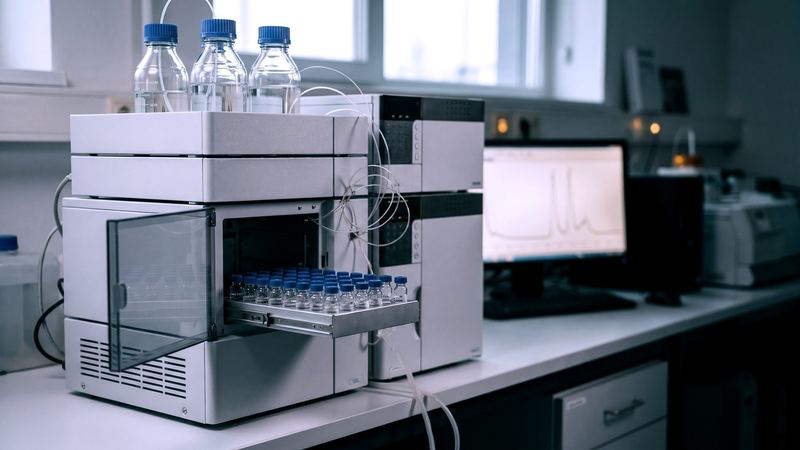
Purification uses the same principle as analytical HPLC on a much larger column. The crude peptide is dissolved, loaded onto a reversed-phase column, and eluted with a gradient of water and acetonitrile containing an acid modifier.
| Step | Purpose |
|---|---|
| Method scouting | Find the gradient that separates the target from its closest impurities |
| Loading | Apply as much crude as the column can resolve |
| Gradient elution | Separate species by hydrophobicity |
| Fraction collection | Collect the eluate in many small portions across the main peak |
| Fraction analysis | Test each fraction by analytical HPLC and mass spectrometry |
| Pooling | Combine only fractions that meet the purity target |
| Recycling | Re-purify side fractions, or discard them |
The purity grade is decided at pooling. A wider cut gives higher yield and lower purity. A narrower cut gives higher purity and lower yield. Impurities that elute very close to the target, such as a deletion of one small residue or a racemized form, limit how far purity can be pushed. The analytical side is explained in HPLC purity explained.
What salt exchange does
Peptides with basic groups are isolated as salts. After purification with TFA in the mobile phase, the counter-ion is trifluoroacetate. If the specification calls for another salt, the counter-ion is exchanged, typically by ion exchange chromatography or by a further reversed-phase run with the new acid in the mobile phase.
| Salt form | Source | Notes |
|---|---|---|
| Trifluoroacetate | Direct from TFA-based purification | Heavier counter-ion; lower net peptide content for the same peptide |
| Acetate | Exchange after purification | Common specification for API and many research-grade items |
| Hydrochloride | Exchange after purification | Used for selected peptides |
The certificate of analysis should name the salt form and report the counter-ion content. Residual TFA may be reported separately on acetate lots. See how to read a peptide COA.
How the bulk is lyophilized
The purified solution is frozen and dried under vacuum to give a dry powder. This removes water and volatile solvents such as acetonitrile. The bulk powder is then tested, packed and either sold as bulk or dissolved, filled into vials and lyophilized again. The cycle is described in lyophilization explained.
How scale changes the process
| Scale | Typical batch | Equipment | Characteristics |
|---|---|---|---|
| Milligram | Up to hundreds of milligrams | Automated bench synthesizer, often with microwave heating | Fast; large reagent excess; used for discovery and custom research items |
| Gram | Grams to tens of grams | Larger synthesizers and glass reactors | Stock research-grade items; method established |
| Kilogram | Hundreds of grams to kilograms | Stirred or filter reactors, large preparative columns, production freeze-dryers | Reagent use optimized; in-process controls; cGMP for API |
At larger scale, mixing, heat removal and washing efficiency behave differently, and reagent excess is reduced to control cost and waste. Long or difficult sequences may be made by fragment condensation, where purified segments are joined, by hybrid solid-phase and solution methods, or by recombinant expression. For API, manufacture follows ICH Q7, and a change of scale is managed under change control.
Where impurities arise
| Process step | Impurities that can form |
|---|---|
| Raw materials | Amino acid derivatives containing the D-isomer, dipeptide or unprotected contaminants, which become insertion or isomer impurities |
| Fmoc deprotection | Incomplete removal gives deletion sequences; aspartimide formation at aspartic acid; diketopiperazine loss at the dipeptide stage |
| Coupling | Incomplete coupling gives deletions; over-activation gives racemization, notably at histidine and cysteine; double coupling gives insertions |
| Capping | Acetylated truncated sequences |
| Cleavage | Incomplete side-chain deprotection; alkylation of tryptophan, methionine, cysteine and tyrosine by protecting-group fragments; oxidation |
| Purification | Co-eluting related peptides remain; residual acetonitrile and TFA |
| Salt exchange | Residual original counter-ion |
| Lyophilization and storage | Residual moisture; oxidation, deamidation and aggregation over time |
Residual solvents are limited under ICH Q3C, published by FDA as guidance on residual solvents. Related-substance limits and identity tests are set in the product specification.
What this means for a buyer
- A purity figure reflects the pooling decision and the analytical method. Ask for the chromatogram.
- The salt form and water content set net peptide content. Ask for both.
- Synthesis site and fill site can differ. Ask where each step took place; see US-made vs imported peptides.
- A change of route, scale or raw material source can change the impurity profile. Ask how changes are notified.
International Wholesale Peptides states origin on every lot. Origin is stated per lot under one of three origin statements. USA-Synthesized: the active is made in the United States, and the lot is filled, finished and tested there. US-Finished: the active is made outside the United States with the source country disclosed, and the lot is filled, freeze-dried, finished and tested in the United States. Standard: the lot is made and finished outside the United States. Details are on the US-synthesized peptides page. Bulk formats are described on the bulk peptides page.
Frequently asked questions
What is solid-phase peptide synthesis?
Solid-phase peptide synthesis builds a peptide on insoluble resin beads. The first amino acid is attached to the resin, and each following amino acid is added in a cycle of deprotection, coupling and washing. Excess reagents are rinsed away, so intermediates do not need isolation.
What does Fmoc mean in peptide synthesis?
Fmoc is the 9-fluorenylmethoxycarbonyl group, a temporary protecting group on the amino end of each incoming amino acid. It is removed with a mild base before the next coupling. Side chains carry acid-labile protecting groups that stay on until the final cleavage.
Why does crude peptide need purification?
No coupling step is perfectly complete, and side reactions occur during synthesis and cleavage. Crude peptide therefore contains deletion sequences, truncated chains, incompletely deprotected material and reagent by-products. Preparative reversed-phase HPLC separates the target from these impurities to reach the specified purity.
Why are peptides supplied as acetate or TFA salts?
Purification normally uses trifluoroacetic acid, so the peptide leaves the column as a trifluoroacetate salt. Many specifications call for acetate, so the counter-ion is exchanged before the final lyophilization. The salt form affects net peptide content and is stated on the certificate.
How does synthesis scale affect a peptide lot?
Milligram and gram batches run on automated synthesizers, and kilogram batches run in large reactors with tighter process control. Larger batches lower cost per gram and give more units per tested lot. Scale changes can alter the impurity profile, which is why they fall under change control.
Are long peptides made the same way?
Stepwise solid-phase synthesis is practical for short and medium-length peptides. Longer sequences may be made by joining purified fragments, by hybrid solid-phase and solution methods, or by recombinant expression in cells. The method should be stated in the manufacturer's documentation.
Related pages
Peptide HPLC purity explainedPeptide HPLC purity is the area of the target peptide peak divided by the total area of all integrated peaks in a reversed-phase chromatogram,…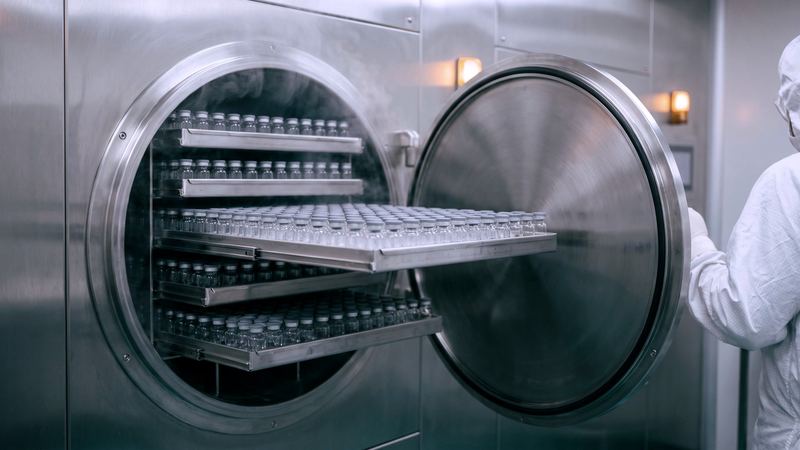 Peptide lyophilization explainedPeptide lyophilization is freeze-drying: the peptide solution is frozen, ice is removed by sublimation under vacuum in primary drying, and bound water is removed…US-synthesized peptides: the USA-Synthesized LineInternational Wholesale Peptides supplies a USA-Synthesized Line to verified trade buyers. The active ingredient is synthesized in the United States, and each lot file…
 Bulk peptides in kits and API powderBulk peptides are supplied in two forms: lyophilized vials in kits of 10 with per-item price breaks at 50, 150, 300 and 500 kits,…