Peptide endotoxin testing and sterility testing
Short answerPeptide endotoxin testing measures bacterial endotoxins with LAL or recombinant reagents under USP <85> and <86>, reported in endotoxin units per milligram or per vial. Sterility testing under USP <71> incubates samples for 14 days to detect viable microorganisms. They are separate tests that answer different questions.
Key facts
- Endotoxin chapter
- USP <85> Bacterial Endotoxins Test
- Recombinant reagent chapter
- USP <86>
- Endotoxin techniques
- Gel-clot, turbidimetric, chromogenic
- Endotoxin units
- EU/mg, EU/mL or EU/vial
- Sterility chapter
- USP <71> Sterility Tests
- Sterility incubation
- 14 days in two media
- Sterility result wording
- No growth, or complies
Peptide endotoxin testing and sterility testing are the two microbiological tests buyers see most often on a certificate of analysis. They measure different things by different methods. This guide explains the LAL and recombinant methods, USP <85>, sterility under USP <71>, when each applies and how results appear on a certificate.
What endotoxin and sterility tests measure
| Question | Endotoxin test | Sterility test | Bioburden test |
|---|---|---|---|
| What it detects | Lipopolysaccharide from Gram-negative bacterial cell walls | Viable bacteria and fungi able to grow in the test media | Number of viable microorganisms |
| Detects dead bacteria | Yes, their endotoxin | No | No |
| Compendial chapter | USP <85>, USP <86> | USP <71> | USP <61> |
| Time to result | Hours | At least 14 days | Several days |
| Result format | Quantity, in endotoxin units | Growth or no growth | Colony-forming units per gram or per mL |
| Applies to | Materials with an endotoxin specification | Products presented as sterile | Non-sterile bulk materials |
Endotoxin is heat-stable and survives sterilizing filtration, so it has to be controlled at the source: water, raw materials, equipment and handling.
How peptide endotoxin testing works
USP general chapter <85> Bacterial Endotoxins Test is harmonized with the European and Japanese pharmacopoeias. It describes three techniques that use Limulus amebocyte lysate (LAL), a reagent from horseshoe crab blood cells.
| Technique | How it is read | Output | Notes |
|---|---|---|---|
| Gel-clot | A firm gel forms if endotoxin is at or above the lysate's sensitivity | Limit test, or semi-quantitative by dilution series | Simple; the referee method where results conflict, unless the monograph says otherwise |
| Turbidimetric | Increase in turbidity as the clot forms | Quantitative, endpoint or kinetic | Automated plate or tube readers |
| Chromogenic | Color released from a synthetic substrate | Quantitative, endpoint or kinetic | Less affected by sample turbidity |
Results are expressed in endotoxin units (EU), calibrated against a reference standard endotoxin.
Recombinant methods
Recombinant Factor C (rFC) and recombinant cascade reagents (rCR) reproduce the endotoxin-sensitive proteins without animal-derived lysate. USP has introduced a separate chapter, <86> Bacterial Endotoxins Test Using Recombinant Reagents, for these methods. Chapter <85> remains in place. A certificate should state which chapter and technique the laboratory used.
Why peptides need interference testing
Peptides can interfere with the assay. Some inhibit the enzyme cascade, some enhance it, and some bind endotoxin so that it is not detected. The chapter therefore requires a test for interfering factors: the sample is spiked with a known amount of endotoxin, and the recovery must fall within the acceptance range. If it does not, the laboratory dilutes the sample, within the maximum valid dilution, or adjusts the conditions. A valid report shows that this suitability test was performed for the product.
FDA's guidance Pyrogen and Endotoxins Testing: Questions and Answers addresses sampling, pooling, retesting and alternative methods.
How endotoxin limits are set
For a finished drug, the limit is calculated under the pharmacopoeial formula from how the product is given. That calculation belongs to the manufacturer or the pharmacy responsible for the finished product. For bulk API and research-grade material, the limit is a specification value, usually stated in EU per milligram. Compare the result with the limit on the certificate and with your own specification.
How sterility testing works under USP <71>
USP general chapter <71> Sterility Tests is also harmonized internationally. It applies to substances and preparations required to be sterile.
| Element | Requirement in outline |
|---|---|
| Methods | Membrane filtration, or direct inoculation of the culture medium |
| Media | Fluid thioglycollate medium, mainly for anaerobic and some aerobic bacteria; soybean-casein digest medium for aerobic bacteria and fungi |
| Incubation temperature | 30 to 35 °C for fluid thioglycollate; 20 to 25 °C for soybean-casein digest |
| Incubation time | Not less than 14 days |
| Sample size | Set by the chapter's tables according to batch size and container volume |
| Method suitability | The product must be shown not to inhibit growth of specified test organisms |
| Result | No evidence of microbial growth, or growth observed |
Membrane filtration is preferred for products with antimicrobial properties, because the filter can be rinsed before incubation. Method suitability, also called bacteriostasis and fungistasis testing, matters for peptides with antimicrobial activity.
What a sterility test cannot show
The test examines a limited number of units. It can detect gross contamination of a lot. It cannot prove that every unit is sterile. Sterility assurance comes from the process: validated sterilizing filtration, aseptic filling in classified areas, environmental monitoring, media fill simulations and container closure integrity. FDA's guidance on sterile drug products produced by aseptic processing describes those controls.
A supplier that claims sterility should be able to describe the fill process as well as show a test result.
When each test applies
| Product | Endotoxin | Sterility | Bioburden |
|---|---|---|---|
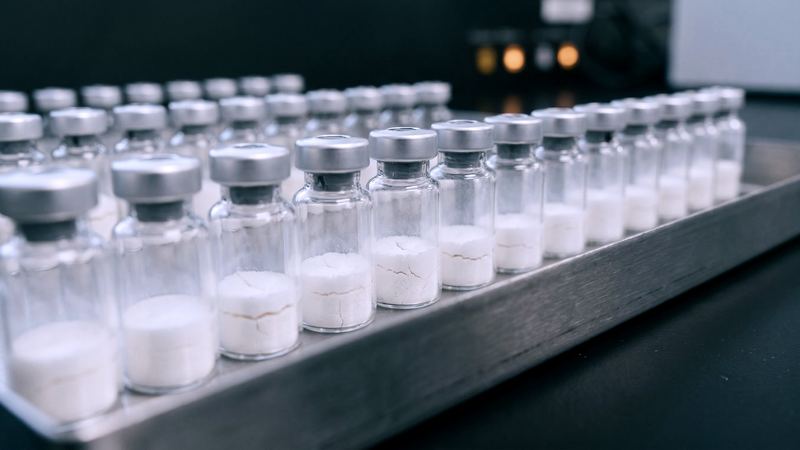
| Aseptically filled lyophilized vials presented as sterile | Yes | Yes | Not on the finished vial; controlled before filtration |
| Lyophilized vials not presented as sterile | Where specified | No | Where specified |
| Bulk API powder for pharmacy or manufacturing use | Yes, where the specification requires it | No, unless sold as sterile | Yes |
| Cosmetic peptide actives | Not normally | No | Microbial limits appropriate to cosmetic raw materials |
For API buyers, the specification decides. Under the HHS draft policy published on October 30, 2026 for six peptides, the certificate criteria for the bulk substance include endotoxin and bioburden where relevant to the product form; see 503A and 503B peptide sourcing.
Presenting a product as sterile is a claim with regulatory weight. It should appear only where the process and the test support it.
How results appear on a certificate of analysis
| Row on certificate | Example entry | How to read it |
|---|---|---|
| Bacterial endotoxins, USP <85>, kinetic chromogenic | Limit: NMT 5 EU/mg. Result: < 0.5 EU/mg | Below the limit. The "less than" value is the detection limit at the dilution tested |
| Bacterial endotoxins, gel-clot | Limit: NMT 10 EU/mg. Result: Complies | A limit test; no numerical value |
| Sterility, USP <71>, membrane filtration | Result: No growth after 14 days | Passed for the units tested |
| Bioburden, total aerobic microbial count | Limit: NMT 100 CFU/g. Result: < 10 CFU/g | Below the limit |
The figures are illustrative, not specifications. NMT means "not more than".
Check five things:
- The method and chapter are named.
- The limit and the result use the same units.
- The units match the product: EU per milligram for powder, EU per vial or per mL for filled product.
- The test date falls after manufacture and before release.
- The laboratory is named and its accreditation scope covers microbiological testing under ISO/IEC 17025.
A sterility result dated fewer than 14 days after the sample was taken cannot be a completed compendial test. General certificate checks are in how to read a peptide COA.

What to ask a supplier
- Whether endotoxin was tested on this lot or on the bulk before filling.
- Which technique was used, and whether interference testing was done for this peptide.
- Whether the product is presented as sterile, and by what process.
- Which sterility method was used and whether method suitability was shown.
- Which laboratory performed the tests.
- How samples were taken and how many units were tested.
What International Wholesale Peptides reports
Every lot ships with a certificate of analysis that names the testing laboratory. It reports identity by mass spectrometry, purity by HPLC and peptide content, and where relevant endotoxin and sterility. The quality page lists the test panel by product class, the certificate of analysis page shows the format, and the lyophilized vials page describes the vial format.
Frequently asked questions
What is the difference between endotoxin testing and sterility testing?
Endotoxin testing measures lipopolysaccharide from the cell walls of Gram-negative bacteria, which persists after the bacteria are dead. Sterility testing looks for living microorganisms that can grow in culture media. A product can be sterile and still contain endotoxin, so the two tests are not interchangeable.
What is the LAL test?
The Limulus amebocyte lysate test uses an extract from horseshoe crab blood cells that reacts with bacterial endotoxin. The reaction is read as a gel clot, as turbidity or as a color change. It is the compendial method described in USP chapter <85>.
What is recombinant Factor C?
Recombinant Factor C is a laboratory-made version of the endotoxin-sensitive protein in the horseshoe crab clotting cascade. It detects endotoxin by fluorescence without animal-derived lysate. USP chapter <86> covers bacterial endotoxin tests that use recombinant reagents, alongside the lysate methods in chapter <85>.
Does every peptide lot need a sterility test?
No. Sterility testing applies to products presented as sterile, such as aseptically filled vials. Bulk powder that is not sold as sterile is normally tested for bioburden, which counts microorganisms, and for endotoxin where the specification requires it.
How does an endotoxin result appear on a certificate of analysis?
It appears as a row naming the test and method, a limit and a result, for example a limit of not more than a stated number of EU per milligram and a result below that figure. Results below the assay's sensitivity are reported as less than the detection limit.
Does a passing sterility test prove a lot is sterile?
No. The test examines a small sample, so it can detect gross contamination but cannot prove the absence of contamination in every unit. Sterility assurance comes from a validated aseptic process or sterilization process, environmental monitoring and container closure integrity, supported by the test.
Related pages
Peptide quality testing and documentationEvery International Wholesale Peptides lot ships with a certificate of analysis that names the testing laboratory and reports identity by mass spectrometry, purity by… Peptide certificate of analysis: what ours shows and how to verify itA peptide certificate of analysis should name the product, lot number, manufacturing origin and testing laboratory, and report identity by mass spectrometry, purity by…How to read a peptide COATo read a peptide COA, match the lot number to the label, confirm identity by comparing observed and theoretical mass, read HPLC purity as…
 Lyophilized peptide vials wholesaleInternational Wholesale Peptides sells lyophilized peptide vials wholesale to verified trade buyers in kits of 10 vials. Each lot carries a certificate of analysis…