Peptide lyophilization explained
Short answerPeptide lyophilization is freeze-drying: the peptide solution is frozen, ice is removed by sublimation under vacuum in primary drying, and bound water is removed by desorption in secondary drying. The result is a dry cake with low residual moisture that is far more stable than solution.
Key facts
- Stage 1
- Freezing: water becomes ice; solutes concentrate
- Stage 2
- Primary drying: ice sublimes under vacuum
- Stage 3
- Secondary drying: bound water desorbs at higher shelf temperature
- Critical limit
- Product temperature stays below the collapse temperature
- Common bulking agents
- Mannitol, glycine
- Common stabilizers
- Sucrose, trehalose
- Moisture test
- Karl Fischer titration
Peptide lyophilization, or freeze-drying, is the step that turns a purified peptide solution into a dry, stable solid. It happens twice in many supply chains: once for the bulk powder after purification, and again in the vial during fill and finish. This guide explains the cycle, excipients, residual moisture, cake appearance and why each matters for stability.
How peptide lyophilization works
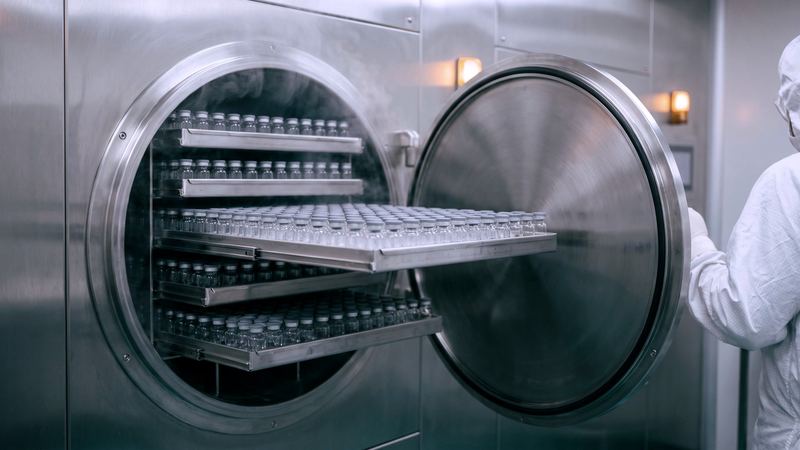
Freeze-drying removes water without passing through the liquid state. At low pressure, ice turns directly to vapor. This is sublimation. The vapor travels to a condenser that is colder than the product and freezes there.
A freeze-dryer has four main parts.
| Part | Function |
|---|---|
| Shelves | Hold the vials or trays; a heat-transfer fluid cools and heats them under program control |
| Chamber | Sealed space that holds vacuum |
| Condenser | Very cold surface that traps water vapor as ice |
| Vacuum system | Lowers chamber pressure so that sublimation can occur |
FDA's inspection guide on lyophilization of parenterals describes the process and the controls an inspector looks for.

What happens in each stage of the freeze-drying cycle
| Stage | What happens | Typical control parameters | What can go wrong |
|---|---|---|---|
| Loading | Filled vials with partly seated stoppers are placed on shelves | Shelf temperature, time before freezing | Solution degradation if held too long |
| Freezing | Water forms ice crystals; solutes concentrate between them | Cooling rate, final shelf temperature, hold time | Incomplete freezing; variable ice structure between vials |
| Annealing (optional) | Product is warmed slightly, held, then recooled | Temperature and time | Not applied when needed, giving small ice crystals and slow drying |
| Primary drying | Ice sublimes under vacuum; heat is supplied by the shelves | Shelf temperature, chamber pressure, time | Collapse or meltback if product temperature is too high |
| Secondary drying | Unfrozen, bound water desorbs | Higher shelf temperature, low pressure, time | High residual moisture if too short; degradation if too hot |
| Stoppering | Stoppers are pressed home inside the chamber | Vacuum or inert gas backfill pressure | Poor seal; loss of headspace condition |
| Unloading and capping | Vials are removed and crimp-sealed | Time to capping | Stopper lift before the crimp is applied |
Freezing
Freezing sets the structure of the final cake. Ice crystals become the pores left behind after drying. Slow cooling and annealing give larger crystals and larger pores, which let vapor escape more easily in primary drying. The product must be cooled below the temperature at which the concentrated solute phase solidifies: the glass transition temperature of the freeze concentrate for amorphous systems, or the eutectic temperature for crystalline ones.
Primary drying
Primary drying is the longest stage. Chamber pressure is lowered and shelf temperature is raised to supply the heat that sublimation consumes. The governing rule is that product temperature at the sublimation front must stay below the collapse temperature. Above it, the solid softens and the pore structure fails. Cycle development balances speed against that limit.
Secondary drying
When the ice is gone, water still clings to the solid. The shelf temperature is raised in a controlled ramp so that this water desorbs. The end point is defined by residual moisture, not by time alone.
Which excipients and bulking agents are used
A vial that contains only a few milligrams of peptide may not form a robust cake. Excipients solve that and protect the peptide during freezing and drying.
| Excipient class | Examples | Role | Behavior on freeze-drying |
|---|---|---|---|
| Bulking agent | Mannitol, glycine | Gives the cake mass and mechanical structure | Crystallizes; supports the cake |
| Lyoprotectant or stabilizer | Sucrose, trehalose | Replaces water around the peptide and forms a glass | Stays amorphous; needs low drying temperature |
| Buffer | Acetate, citrate, histidine | Controls pH before freezing | Some buffers shift pH on freezing |
| Tonicity agent | Salts | Adjusts the solution | Lowers collapse temperature; kept to a minimum |
Excipient choice affects the cycle. A crystalline bulking agent tolerates higher drying temperatures. An amorphous sugar protects the peptide well but collapses at a lower temperature, so the cycle runs colder and longer.
Research-grade vials are often filled without excipients, or with a bulking agent only. The label and certificate should state what the vial contains besides the peptide. Bulk powder lyophilized after purification normally contains no added excipient. It contains the peptide, its counter-ion and residual water, as described in peptide synthesis explained.
Why residual moisture matters
Residual moisture is the water remaining in the dried product. It is measured by Karl Fischer titration and reported as percent by mass.
| Residual moisture | Effect |
|---|---|
| Low, within specification | Low molecular mobility; slow degradation; firm cake |
| Above specification | Faster hydrolysis, deamidation and aggregation; cake may shrink or soften on storage |
| Rising during storage | Indicates moisture transfer from the stopper or a closure defect |
Specifications for lyophilized products commonly set residual moisture at a low single-digit percentage. The right limit is the one supported by the product's stability data, because some peptides tolerate more water than others.
Two sources add moisture after drying. Stoppers hold water and release it into the cake over time unless they are dried before use. A poor seal lets humid air in. Both show up as a moisture trend in stability studies. Stability conditions are defined in ICH Q1A(R2).
Water also counts in the mass balance of the powder. It is one reason net peptide content is lower than HPLC purity; see how to read a peptide COA.
What cake appearance tells you
Appearance is an attribute on most certificates. It is a useful first check at receipt, with limits.
| Observation | Likely cause | Significance |
|---|---|---|
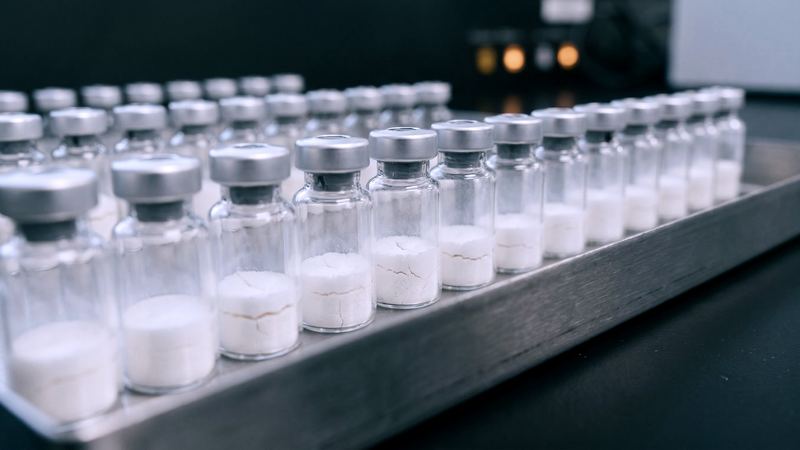
| Uniform, intact cake filling the original liquid volume | Cycle ran below collapse temperature | Expected result for formulated product |
| Slight shrinkage from the vial wall | Normal contraction of amorphous cakes | Usually cosmetic |
| Cracks | Stress during drying | Usually cosmetic |
| Collapse: cake reduced, glassy or sunken | Product temperature above collapse temperature | Process deviation; check moisture and purity |
| Meltback: dense ring or film at the bottom | Ice remained when the shelf temperature was raised | Process deviation; local high moisture |
| Thin film or small plug, little visible material | Low fill mass with no bulking agent | Normal for excipient-free vials; confirm content by test |
| Loose powder | Cake broke in transit, or low-solids fill | Check the seal; usually cosmetic |
| Color different from the certificate description | Degradation or a different material | Hold and report to the supplier |
Cosmetic variation does not indicate a quality defect. Collapse and meltback are worth a question to the supplier, because they can go with higher residual moisture. Appearance never measures content. Fill quantity is established by the certificate and by testing.
Why lyophilization matters for stability and supply
| Property | Solution | Lyophilized solid |
|---|---|---|
| Chemical stability | Limited; hydrolysis and deamidation proceed | Much greater when dry and cold |
| Storage | Frozen, with freeze-thaw risk | Frozen or refrigerated, as labeled |
| Transport | Heavy; sensitive to thawing | Light; more tolerant of short excursions, within stability data |
| Sensitivity after opening | Not applicable | Hygroscopic; takes up moisture from air |
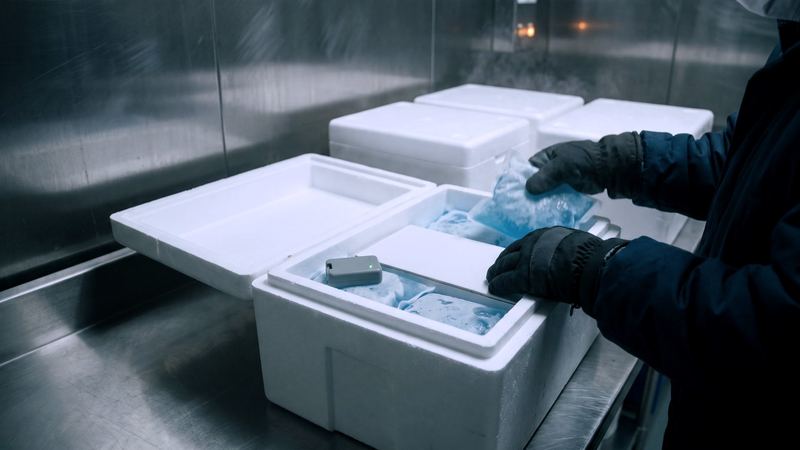
A good cycle gives a product that holds its purity through storage and shipping. A poor cycle gives a product that passes release testing and then degrades faster than its date implies. That is why moisture results and stability data belong in a supplier review. Warehouse handling is covered in peptide storage and cold chain.
What to ask a supplier about lyophilization
- Where the fill and lyophilization took place for this lot.
- Whether the vial contains excipients, and which.
- The residual moisture limit and the result for this lot.
- Whether vials are stoppered under vacuum or inert gas.
- What stability data supports the storage condition and date.
- How cake appearance is specified and inspected.
International Wholesale Peptides states origin on every lot. Origin is stated per lot under one of three origin statements. USA-Synthesized: the active is made in the United States, and the lot is filled, finished and tested there. US-Finished: the active is made outside the United States with the source country disclosed, and the lot is filled, freeze-dried, finished and tested in the United States. Standard: the lot is made and finished outside the United States. Each lot ships with a certificate of analysis that names the testing laboratory. See the lyophilized vials page for the format and the quality page for the test panel.
Frequently asked questions
Why are peptides lyophilized?
Most peptide degradation reactions need water. Removing water slows hydrolysis, deamidation and aggregation, so a lyophilized peptide keeps its purity far longer than the same peptide in solution. Dry product is also lighter and more tolerant of transport than frozen liquid.
What are the three stages of a freeze-drying cycle?
Freezing converts water to ice. Primary drying removes that ice by sublimation under vacuum while the product stays below its collapse temperature. Secondary drying raises the shelf temperature to remove water that remains bound to the solid. Vials are then stoppered inside the chamber.
What is residual moisture and why does it matter?
Residual moisture is the water left in the cake after drying, measured by Karl Fischer titration and reported as percent by mass. Higher moisture increases molecular mobility and speeds degradation. The acceptable level is set per product from stability data.
What does a collapsed lyophilized cake mean?
Collapse means the dried structure lost its shape during primary drying, usually because product temperature exceeded the collapse temperature. A collapsed cake can hold more moisture and dry unevenly. It is a process deviation that should be assessed against moisture and purity results.
What is a bulking agent in a lyophilized peptide?
A bulking agent is an excipient, commonly mannitol or glycine, that gives the cake mass and structure when the amount of peptide per vial is small. Without it, a low-fill vial may show a thin film or loose powder that can be lost during drying.
Is a vial with little visible powder underfilled?
Not necessarily. Milligram quantities of peptide without a bulking agent can form a thin film or a small plug that is hard to see. Appearance does not measure content. The certificate of analysis and, if needed, an independent content test answer that question.
Related pages
 Lyophilized peptide vials wholesaleInternational Wholesale Peptides sells lyophilized peptide vials wholesale to verified trade buyers in kits of 10 vials. Each lot carries a certificate of analysis…
 Peptide storage and shipping: cold chain for warehouse stockLyophilized peptide stock is stored sealed, dry, dark and cold, at the temperature on the label, commonly frozen for long-term holding or refrigerated for…How peptides are synthesized: from resin to lyophilized powderMost commercial peptides are made by Fmoc solid-phase peptide synthesis: amino acids are coupled one at a time to a chain anchored on resin,…
 Peptide quality testing and documentationEvery International Wholesale Peptides lot ships with a certificate of analysis that names the testing laboratory and reports identity by mass spectrometry, purity by…